AI Citation Monitor: How to Track Your Brand Across ChatGPT, Perplexity, Gemini, and Google AI Overviews
AI Overviews and chatbots now answer questions Google Search Console can't see. Here's how to monitor AI citations across ChatGPT, Perplexity, Gemini, and AI Overviews.
If you're wondering why use AI search monitoring tools in the first place, here's the short version: your existing SEO dashboard can't see what AI engines are telling people about you. Google Search Console tracks rankings and clicks. It has no idea whether ChatGPT just quoted your pricing wrong, or whether Perplexity cited a competitor for the exact question your product answers best.
That blind spot is why AI citation monitoring has become its own category in 2026, separate from classic rank tracking. This guide covers what it actually means, the four AI surfaces that matter most, the metrics worth watching, and how to start tracking your brand without burning a week on manual prompt testing.
None of this replaces traditional SEO. Think of it as a parallel scoreboard. You still need to rank, but ranking well no longer guarantees that an AI engine quotes you, credits you, or even gets your facts right when someone asks about your category.
Why AI Citation Monitoring Sits Above Rank Tracking
Search Console was built for a web of blue links. Google blends AI Overview clicks into standard organic data and gives you no native way in Search Console or GA4 to isolate AI Overview impressions, citations, or clicks. So if your content gets pulled into an AI Overview or named as a source in ChatGPT, you can be the primary reference driving someone's decision and never see it in your usual reports.
That matters more than it did a year ago. Depending on whose methodology you trust, AI Overview prevalence estimates for 2026 range from roughly 21% up to 60%+ of queries, with most credible trackers landing between a quarter and half, according to AI Overview tracking research from QuickSEO.
The traffic effect is real too. Ahrefs' own analysis of 150,000 AI Overview-triggered keywords found a 34.5% drop in position #1 click-through rate after AI Overviews rolled out, and CTR fell a further 42-44% on keywords where they'd confirmed a citation. The searches you used to win on rankings alone are quietly becoming AI answers instead of clicks. If you're not watching what those answers say about you, you're flying blind on a growing slice of your funnel.
There's a second risk hiding in that same blind spot. It's not just that you might be missing from an AI answer. It's that the AI might mention you and get something wrong, and you'd have no way to know unless someone forwarded you a screenshot. Citation monitoring catches both problems at once: the absence and the inaccuracy.
This is the same blind spot we cover from a different angle in 10 Signs Your Website Is Invisible to AI Search Engines, which walks through the symptoms before you even get to monitoring.
The Four Surfaces That Matter, and Why They Don't Behave the Same Way
ChatGPT, Perplexity, Gemini, and Google AI Overviews all answer questions, but they don't source those answers the same way. Treating them as one undifferentiated "AI search" bucket is how teams end up optimizing for the wrong platform.
A 2026 per-engine citation audit found that only about 11% of domains cited by ChatGPT overlap with the domains cited by Perplexity, per AI share of voice research from Digital Applied. Ranking well in one engine's citation pool tells you almost nothing about the other.
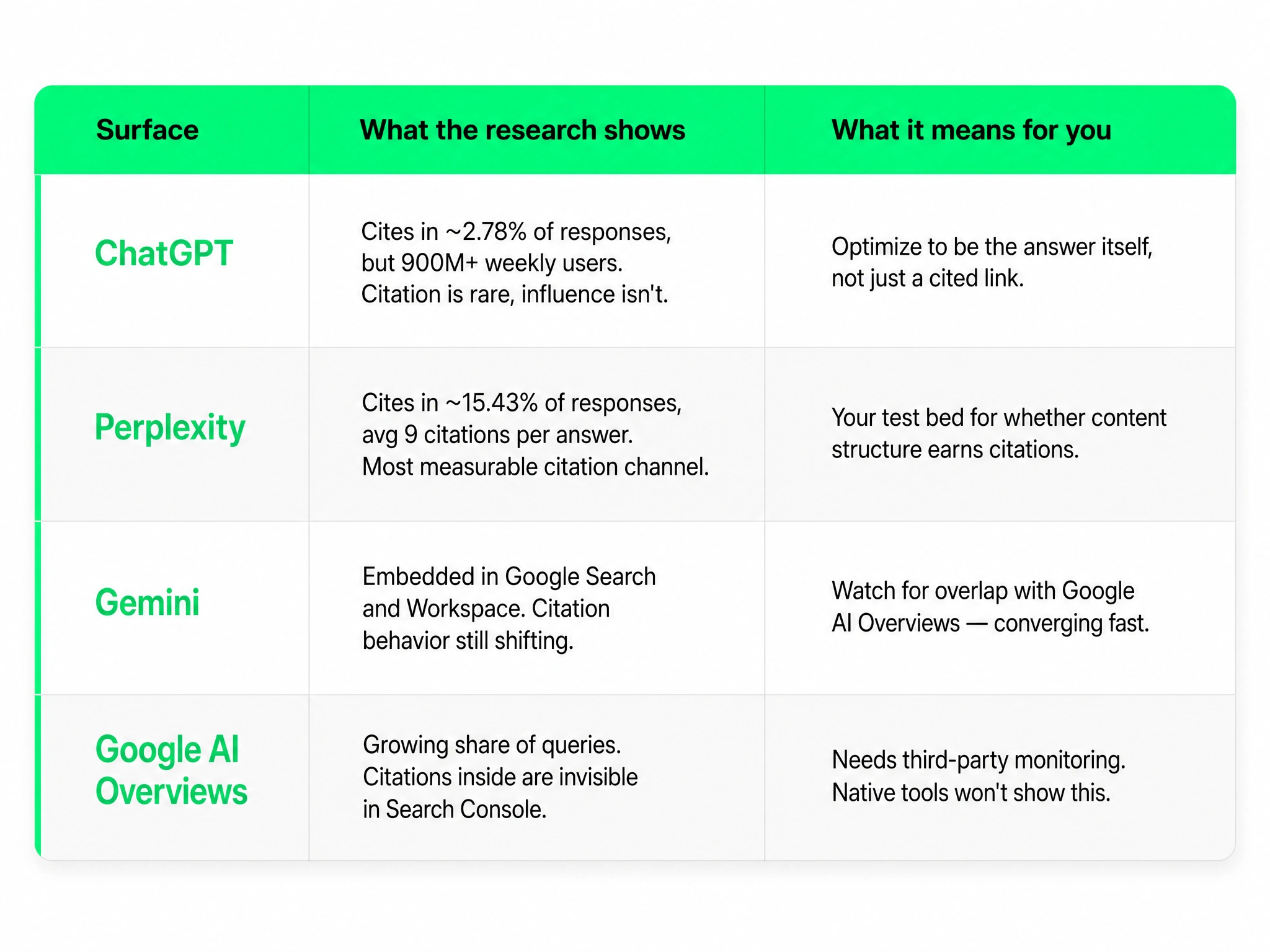
What the research shows vs. What it means for you
ChatGPT
Cites sources in only about 2.78% of responses, but reaches 900M+ weekly users, the largest pool of any AI platform, per TechCrunch via Demand Local.
Optimize to be the answer itself, not just a cited link. Citation is rare here, influence isn't.
Perplexity
Cites sources in roughly 15.43% of responses, with an average of nearly 9 citations per answer, making it the most measurable citation channel of the four.
Use Perplexity as your test bed for whether your content structure actually earns citations.
Gemini
Increasingly embedded across Google Search and Workspace, with citation behavior that's still shifting as Google folds it deeper into core products.
Watch for overlap with Google's own AI Overviews, since the two are converging.
Google AI Overviews
Appears on a large and growing share of queries, and citations inside it are invisible in Search Console.
Needs third-party or dedicated monitoring, since Google's native tools won't show you this.
ChatGPT: low citation rate, outsized influence
ChatGPT's low citation rate doesn't mean it doesn't matter. It crossed 900 million weekly active users in 2026, by far the largest reach of any AI platform, so even a low citation rate translates into a massive number of answers that could mention your brand. The practical takeaway is that ChatGPT often answers from its training data and general knowledge rather than pulling a live source, so showing up as a cited link is the exception, not the rule.
That means your goal with ChatGPT looks different than your goal with Perplexity. You're trying to become part of the model's baseline understanding of your category, which happens through consistent, repeated, accurate mentions across the web over time, not through a single optimized blog post.
Perplexity: the most measurable citation channel
Perplexity behaves more like a research assistant. It cites sources far more often and tends to show several citations per answer, which makes it the easiest of the four platforms to actually test against. If you want a fast read on whether a piece of content is structurally citable, run it through Perplexity first.
Gemini: converging with Google Search itself
Gemini sits in an odd spot because Google keeps folding it deeper into Search, Workspace, and Android. Its citation logic increasingly overlaps with how AI Overviews pull sources, which means improvements you make for one often help the other. Treat Gemini and AI Overviews as a connected pair rather than two separate optimization targets.
Google AI Overviews: the highest-volume blind spot
AI Overviews show up on a large and growing share of everyday queries, which makes them the highest-stakes surface simply on volume. They're also the surface where Google gives you the least native visibility, since Search Console won't tell you when you're cited inside one. That combination, high volume plus zero native visibility, is exactly why dedicated monitoring earns its keep here first.
Citation Rate and Share of AI Voice: The Two Metrics Worth Tracking
Two numbers do most of the work once you start monitoring AI citations seriously.
Citation rate is the percentage of relevant AI answers that name your brand or link to your content as a source, out of all the answers you tested or tracked for that topic.
Share of AI voice is your brand's citations across all tracked platforms, divided by the total citations earned by every brand in your category for the same set of prompts, multiplied by 100.
Here's a simple version of the math. If you track 50 category prompts across four platforms (200 total responses) and your brand shows up as a cited source in 18 of them, your citation rate is 9%. If your three closest competitors combined earn 90 citations across those same 200 responses, and you earned 18 of that 108-citation pool, your share of AI voice is 16.7%.
Both matter because they're still rare in most marketing stacks. Only about 14% of marketers currently track AI citations at all, even though 43% now name AI search optimization a core part of their 2026 strategy, per AI share of voice research from Digital Applied. That gap is an opportunity if you close it early.
For a step-by-step walkthrough of testing this manually before you automate it, see How to Track Your Brand Mentions in ChatGPT and Perplexity.
Manual Spot-Checking vs Automated Monitoring
Prompt auditing, where you manually run a set of category questions through each platform and log what comes back, is a legitimate way to start. It costs nothing but time, and it'll teach you fast how differently each engine treats your brand.
A simple version: write down 10 to 15 questions a buyer would realistically ask about your category, run each one through ChatGPT, Perplexity, Gemini, and an incognito Google search to trigger an AI Overview, then log whether you appear, whether you're cited, and whether anything stated about you is wrong.
It just doesn't scale. You'd need to re-run the same prompts across four platforms every time a model updates, every time a competitor publishes something new, and ideally every week to catch trend shifts. Most teams do it once, call it an audit, and move on, which means they miss the exact moment their citation rate starts sliding.
There's also a content-side piece to this. Even a perfect monitoring setup won't fix citations you're not structurally earning. That's covered in LLM SEO: How to Optimize Your Content for ChatGPT, Perplexity, and Google AI, which goes deeper into the on-page side of the equation.
What to Look for in an AI Citation Monitoring Tool
Not every tool labeled "AI visibility" actually tracks citations the same way. Before you commit to one, check it against this list.
1. Coverage across ChatGPT, Perplexity, Gemini, and Google AI Overviews, not just one or two. A tool that only checks one platform will give you a skewed picture, since the data above shows how little overlap exists between them.
2. A clear distinction between a mention (your name shows up) and a citation (you're named as the source). These get conflated constantly, and the difference changes how you should react to the data.
3. Alert speed fast enough to catch a drop within days, not at the next monthly report. Model updates can shift citation behavior overnight, and a monthly cadence means you find out a month late.
4. Historical trend data, so a single bad week doesn't get mistaken for a real decline. AI answers can vary response to response, so you need enough history to tell signal from noise.
5. Integration with the rest of your SEO stack, so citation data sits next to rankings and traffic instead of living in its own silo that nobody checks.
How Serpely's AI Citation Monitor Pulls This Together
Serpely's AI Citation Monitor runs the four-surface check automatically instead of asking your team to do it by hand every week. It pulls citation data from ChatGPT, Perplexity, Gemini, and Google AI Overviews into one dashboard, tracks your citation rate trend over time, and fires an alert the moment your brand gains or loses mentions on any of the four.
In practice, that looks like a weekly digest showing your citation rate by platform, a trend line so you can see whether you're moving up or down, and a flagged list of any new competitor that started showing up in your tracked prompts. Instead of running the same manual audit every week, your team reviews the digest and decides what, if anything, needs action.
That score rolls up into Serpely's GEO Score, a single number meant to answer the question every marketer eventually asks: is my content actually citable right now, or just technically indexed. If you want the full breakdown of what feeds that score, The Citation Readiness Checklist: 13 Signals That Determine Whether AI Engines Cite You covers it in detail.
Reading Your First AI Citation Report
Your first report is going to feel like a lot of numbers. Here's what actually matters when you open it.
Start with the citation rate trend line, not the single current number. A flat 8% citation rate that's been stable for three months tells a different story than a citation rate that just dropped from 15% to 8% in two weeks.
Next, check your share of AI voice against the two or three competitors you actually compete with on rankings. Losing share to a brand you've never heard of usually means nothing. Losing it to your closest competitor means it's time to look at what changed in their content.
Finally, look at the per-surface breakdown. A brand that's strong in Perplexity but invisible in ChatGPT has a different problem than one that's weak everywhere, and the fix looks different too.
As a simple rule of thumb for your first month: don't react to single-week swings, do react to anything that holds for three weeks straight, and always check whether a drop lines up with a known model update before assuming it's something you did.
Common Mistakes Teams Make When They Start Monitoring
The most common mistake is treating one platform's result as the whole picture. A strong Perplexity citation rate can mask a near-zero presence in ChatGPT, and a team that only checks one surface will misread its own visibility.
The second is reacting to a single bad data point. AI answers vary response to response even for the same prompt, so one disappointing check doesn't mean your citation rate actually dropped. Wait for the trend to confirm it.
The third is monitoring without a content plan to act on what you find. A dashboard full of gaps is only useful if someone owns turning those gaps into briefs, fixes, or new content.
Frequently Asked Questions
What's the difference between an AI mention and an AI citation?
A mention is when an AI answer references your brand name without crediting you as a source. A citation is when the AI explicitly names or links to your content as where the information came from. Citations carry more weight for trust and traffic.
Does Google Search Console show AI Overview citations?
No. Search Console blends AI Overview impressions into standard organic data and doesn't separate out whether your page was cited inside the AI Overview text itself. You need a dedicated monitoring tool or third-party platform to see that.
Which AI platform cites the most sources, ChatGPT or Perplexity?
Perplexity cites sources far more often, at roughly 15.43% of responses compared to about 2.78% for ChatGPT. ChatGPT still drives more total AI-assisted traffic, so both are worth tracking for different reasons.
How often should I check my AI citation report?
Weekly is a reasonable baseline for most brands. If you've just published or updated content meant to earn citations, check more often for the first two to three weeks to see if it's working.
Can I track AI citations manually without a tool?
Yes, at a small scale. Pick 10 to 15 prompts your buyers would actually ask, run them across all four platforms, and log the results in a spreadsheet. It works, it just doesn't scale past a handful of topics or stay current as models update.
What's a good citation rate to aim for?
There's no universal benchmark yet since the category is so new, but most brands starting out land in the low single digits. Treat your own baseline as the number to beat, and prioritize consistent upward movement over hitting a specific target.
Does a higher citation rate always mean more traffic?
Not directly. A citation in an AI Overview or Perplexity answer can drive a click, but a ChatGPT mention often satisfies the user's question without sending them anywhere. Treat citation rate as a brand visibility metric first and a traffic metric second.
Should small or local brands bother with AI citation monitoring?
Yes, often more urgently than larger brands. AI engines tend to consolidate answers around a small number of trusted sources per topic, so a local or niche brand that earns early citations can lock in an outsized share of voice before bigger competitors catch on. Waiting usually means competing for a spot that's already been claimed.
Where This Fits Into a Broader GEO Strategy
Citation monitoring is a measurement layer, not a content strategy on its own. It tells you whether what you're already publishing is landing with AI engines, but it won't write the content that earns those citations in the first place.
The brands pulling ahead right now are treating it as a feedback loop. They publish a piece built around a content brief, check how it performs across ChatGPT, Perplexity, Gemini, and AI Overviews two to three weeks later, then feed whatever they learn back into the next brief. Over a few months, that loop compounds into a much sharper sense of what AI engines actually want to cite from a given brand.
That's also why pairing citation monitoring with a GEO-aware content process matters more than either piece alone. A perfectly structured, citation-ready article that nobody is tracking will quietly succeed or fail with no one noticing. A monitoring dashboard with no fresh content behind it will just report the same flat numbers month after month.
If you're building out this process for the first time, start small. Pick five to ten of your highest-intent category questions, track them consistently for a month, and use that month as your baseline before expanding to a full content calendar's worth of topics.
See Where You Actually Stand
Manual prompt testing will tell you where you stand today. It won't tell you the moment that changes. Serpely's AI Citation Monitor tracks ChatGPT, Perplexity, Gemini, and Google AI Overviews continuously and alerts you the moment your citation rate moves.
Start a free trial to see your dashboard, or book a demo if you'd rather walk through it with someone first.