Serpely vs Surfer vs Ahrefs: Which SEO Tool Is Right for AI-First Teams?
Surfer optimizes content. Ahrefs owns backlink data. Neither tracks AI citations. Here's how Serpely vs Surfer vs Ahrefs actually breaks down for 2026.
Surfer SEO vs Ahrefs is one of the most searched SEO tool comparisons out there, and for good reason. Both are excellent at what they were built for. Surfer helps you write content that scores well against on-page factors. Ahrefs helps you research keywords and understand who's linking to whom.
Neither one was built for the world we're actually marketing in right now. In 2026, a growing share of searches never produce a click at all. They produce an AI Overview, a ChatGPT answer, or a Perplexity summary, and your brand either shows up in that answer or it doesn't. That's a different problem than the one Surfer and Ahrefs were designed to solve.
This post breaks down what each tool does well, where the gap actually is, and where a tool like Serpely fits if you're running an AI-first marketing team in 2026.
What Surfer and Ahrefs Each Do Best
Surfer's strength is content optimization. Its Content Editor gives you real-time scoring as you write, based on what's already ranking for your target keyword, and Surfer AI can spin up a full optimized draft from a single keyword in minutes. If your team lives inside a content calendar and needs writers to hit consistent on-page benchmarks, Surfer is genuinely good at that job.
Ahrefs' strength is data depth. Site Explorer, Keywords Explorer, and Site Audit remain some of the most complete tools for understanding backlink profiles, keyword difficulty, and technical crawl issues. If you're an agency managing link strategy across a dozen client sites, Ahrefs is still hard to beat on raw data coverage (Heroic Rankings, 2026).
Both companies know AI search matters. Surfer added an AI Tracker for brand mentions in generative answers, and Ahrefs shipped Brand Radar for the same purpose. That's the right instinct. The execution is where things get shakier.
Where Both Fall Short in 2026
Here's the direct answer: neither tool was architected around AI visibility from the ground up, and it shows in accuracy and coverage.
Take Ahrefs Brand Radar. One independent review tested it against manually verified brand mentions and found it reported just 3 ChatGPT mentions where the real count was 123, and 6 Perplexity mentions where the actual number was 212 (TryProfound, 2026). The gap comes from how it collects data: a static prompt library and periodic snapshots instead of live query monitoring. Neither Brand Radar nor Surfer's AI Tracker natively tracks Claude or Grok either, which matters more every quarter as those models pick up query share.
There's no hallucination alerting in either tool. If an AI model states outdated pricing or a discontinued feature as fact about your brand, you won't hear about it from Surfer or Ahrefs. There's no GEO Score you can track over time the way you'd track domain rating. And reporting in both tools still centers on rankings and traffic, not on whether you're actually being cited inside AI-generated answers.
That last point matters more than it sounds. AI Overviews now appear on roughly 48% of tracked queries as of early 2026, up from 31% a year prior, and organic click-through on those queries dropped from 1.76% to 0.61% (Omnibound, 2026). Brands that do get cited earn about 120% more clicks per impression than uncited brands on the same query. Visibility inside the answer is becoming the whole game, not a side metric.
Head-to-Head: 8 Dimensions That Actually Matter
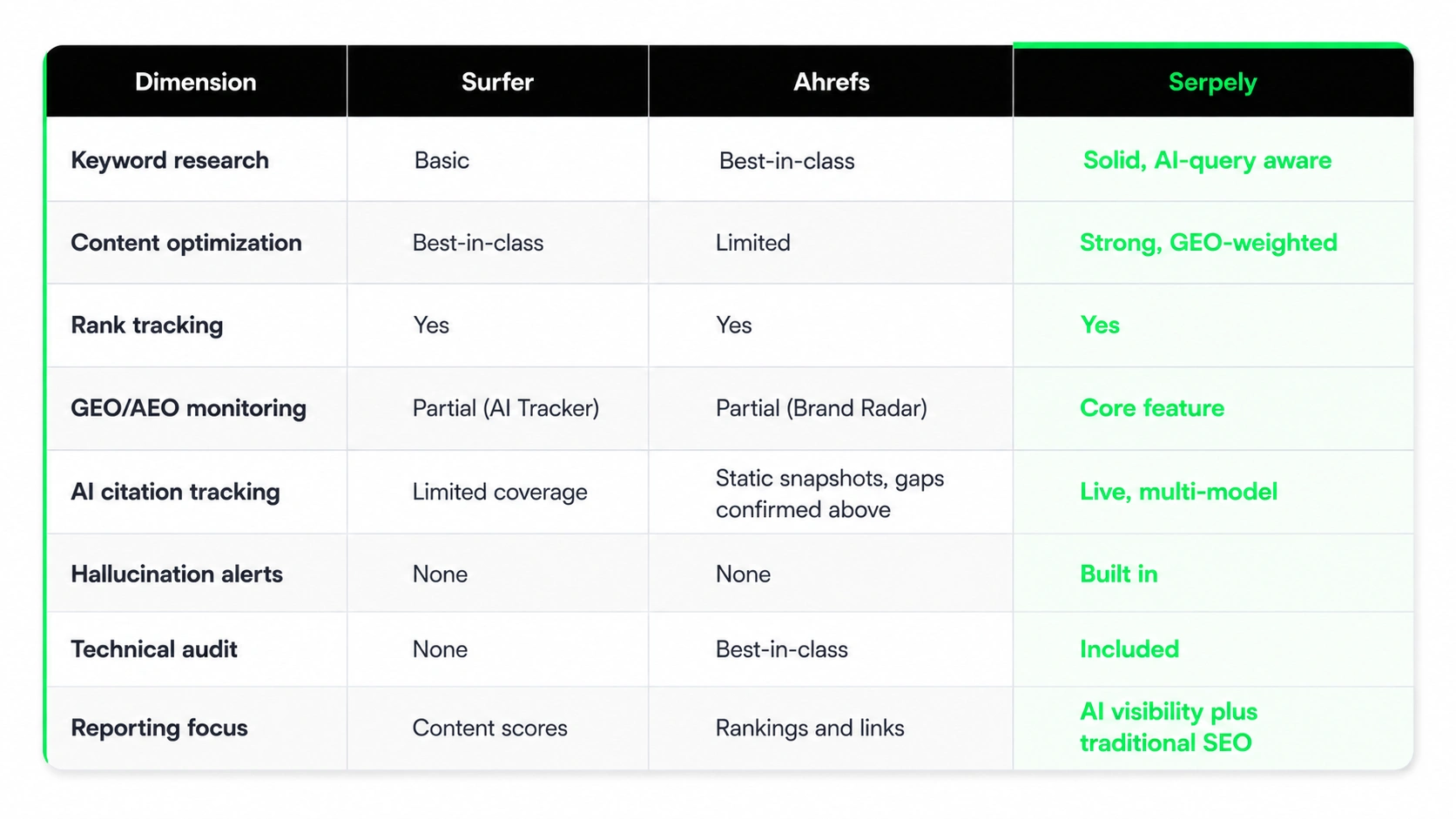
Dimension | Surfer | Ahrefs | Serpely |
|---|---|---|---|
Keyword research | Basic | Best-in-class | Solid, AI-query aware |
Content optimization | Best-in-class | Limited | Strong, GEO-weighted |
Rank tracking | Yes | Yes | Yes |
GEO/AEO monitoring | Partial (AI Tracker) | Partial (Brand Radar) | Core feature |
AI citation tracking | Limited coverage | Static snapshots, gaps confirmed above | Live, multi-model |
Hallucination alerts | None | None | Built in |
Technical audit | None | Best-in-class | Included |
Reporting focus | Content scores | Rankings and links | AI visibility plus traditional SEO |
Who Should Use Which
If your team is entirely writers and editors focused on on-page scoring, Surfer earns its seat. If you're an agency or in-house team that lives and dies by backlink strategy and needs the deepest keyword database available, Ahrefs alternative conversations usually end with people staying on Ahrefs, and that's fair. It's still the standard for link and keyword data.
Where teams get stuck is trying to bolt AI visibility onto either tool as an afterthought. If your mandate now includes "are we showing up when someone asks ChatGPT about this," that's not a feature Surfer or Ahrefs was built around. It's the whole point of a best SEO tool for agencies built for the AI-first era.
Some teams run Ahrefs for link research and layer an AI visibility tool on top instead of switching entirely, which is a reasonable middle path if budget allows for both. For SaaS teams asking "what is the best SEO tool" heading into next year, the honest answer depends on whether AI citation tracking is core to your job description or a nice-to-have.
FAQ
Is Surfer or Ahrefs better for SEO in 2026?
It depends on the job. Surfer is stronger for on-page content optimization and guided writing. Ahrefs is stronger for backlink analysis, keyword research depth, and technical site audits. Neither is built primarily for AI citation tracking.
Can Ahrefs Brand Radar track AI mentions accurately?
Reviews have found significant gaps between what Brand Radar reports and actual AI mentions, largely because it relies on a static prompt library and timed snapshots rather than live monitoring. It's a useful starting signal, not a complete picture.
What is GEO and why does it matter for SaaS teams?
GEO, or generative engine optimization, is the practice of optimizing content so AI models like ChatGPT and Gemini cite your brand in generated answers. It matters because a growing share of searches now resolve inside an AI answer instead of a traditional results page.
Do I need a separate tool for AI citation monitoring?
If AI visibility is part of your reporting mandate, yes, in most cases. Traditional SEO tools were built around rankings and backlinks, and their AI tracking features are newer, narrower add-ons rather than core architecture.
Is Serpely a replacement for Ahrefs or Surfer?
Not necessarily. Many teams keep Ahrefs for link research and use Serpely specifically for AI citation monitoring, GEO scoring, and hallucination alerts, the areas where Ahrefs and Surfer currently have the least coverage.
How much does AI visibility monitoring typically cost?
Pricing varies. Surfer starts around $49/month and Ahrefs' entry plans start near $29 to $99/month depending on the tier, with AI-visibility add-ons like Semrush's AI Toolkit starting at roughly $99/month per domain. Serpely's plans are outlined on the pricing page linked below.
How Serpely Fills the Gap
Serpely's AI Citation Monitor tracks live mentions across ChatGPT, Perplexity, Gemini, and Google AI Overviews, rather than relying on a static prompt library. Because it's watching in near real time instead of periodic snapshots, it's built to catch the kind of accuracy gap that showed up in the Brand Radar review above.
The GEO Score gives you a single number to track AI visibility improvement over time, the same way domain rating became shorthand for backlink strength. And the Actions Hub turns what the AI Citation Monitor finds into specific fixes, like a page missing the structured data or answer-first formatting that AI models tend to cite, instead of just handing you a dashboard and leaving the "now what" to you.
None of this makes Surfer's content editor or Ahrefs' backlink index obsolete. It fills the part of the stack neither one was designed to cover.
Curious how your brand actually shows up across ChatGPT, Perplexity, and Google AI Overviews right now? Try Serpely free for 14 days or view pricing to see where the AI Citation Monitor and GEO Score fit into your stack.