E-E-A-T for LLMs: The Trust Signals That Keep AI Models From Getting You Wrong
Google's ranking factors and LLM grounding signals now overlap. See how E-E-A-T works in AI search and the checklist that keeps AI models from getting you wrong
If you've read any roundup of google search ranking factors 2026, E-E-A-T shows up on nearly every one of them. That's not new. What is new is that E-E-A-T stopped being a “content quality” checkbox and became something closer to an AI citation filter.
Experience, Expertise, Authoritativeness, and Trust used to be about convincing a human quality rater your page was worth ranking. Now the same signals decide whether ChatGPT, Perplexity, and Google's AI Mode consider you reliable enough to cite, or reliable enough to get right when they mention you at all.
This post walks through why that shift happened, exactly which signals AI models weight, and what a practical E-E-A-T checklist looks like when your audience is a language model as much as it is a person.
Where E-E-A-T Sits Among Google Search Ranking Factors 2026
Two years ago, E-E-A-T mostly influenced whether your page ranked on page one. Today it influences something with higher stakes: whether an AI system trusts you enough to mention you accurately, or mentions you at all.
Google's own quality rater guidelines, documented on Search Central, added “Experience” as its own pillar back in 2022, specifically asking whether the content creator has firsthand, real-world involvement with the topic. That distinction matters even more now.
Here's the overlap: the same signals that tell a Google quality rater “this source knows what it's talking about” are the signals a language model uses to decide whether your content is safe to ground an answer in. Author credentials, consistent facts, and citations from trusted domains are not two separate systems anymore.
They're one evidence trail that both traditional search and AI search draw from. Most lists of google search ranking factors 2026 now fold E-E-A-T in alongside Core Web Vitals and content quality for exactly this reason.
The catch is that traditional rankings and AI citations don't always move in lockstep. A page can rank well in classic search and still get skipped by an AI model that's weighing a slightly different mix of the same underlying signals.
The Signals AI Models Actually Weight When Deciding Who to Cite
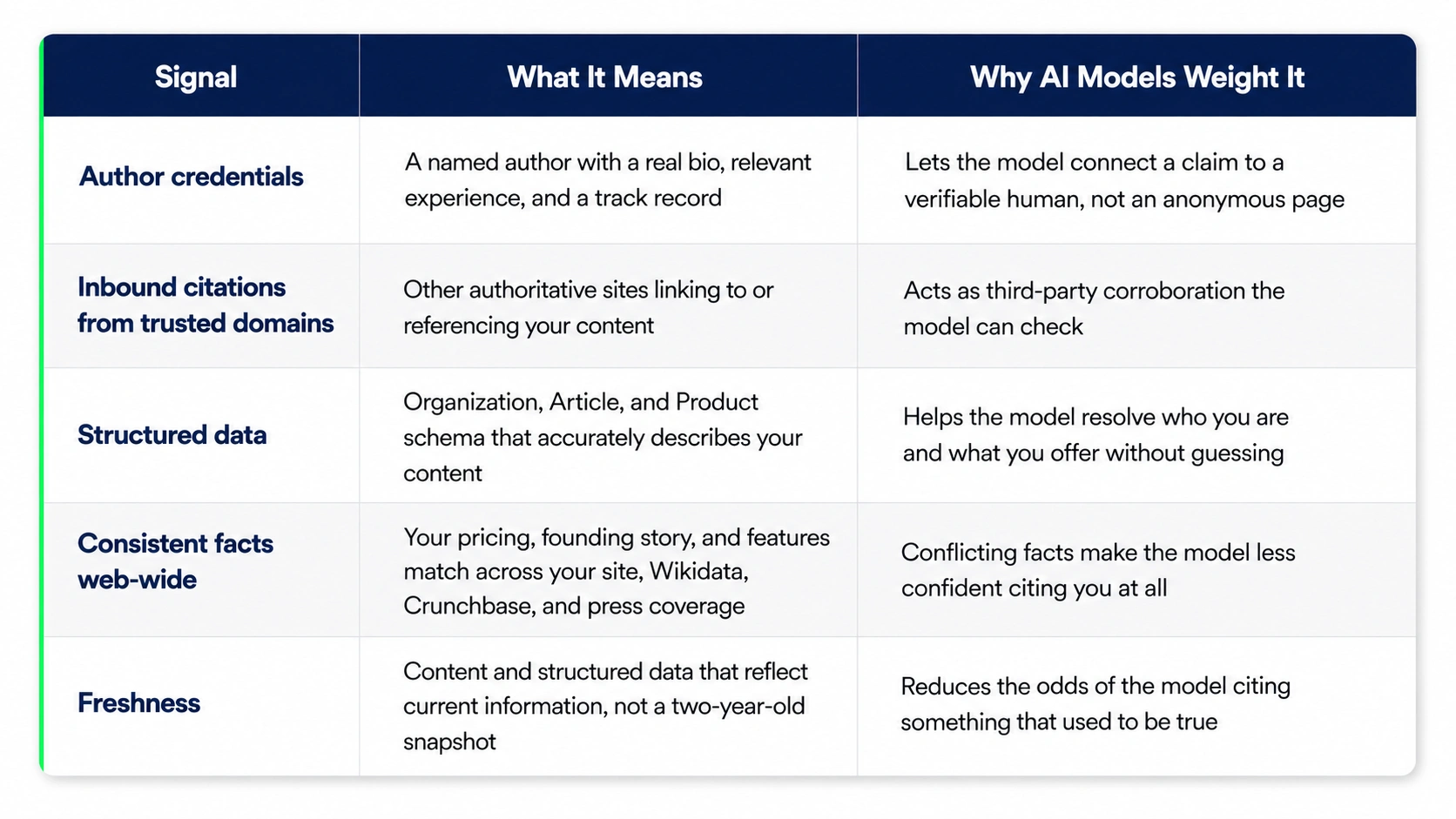
Not every E-E-A-T signal carries equal weight in AI search. A few show up consistently across how these systems evaluate sources.
Signal
What It Means
Why AI Models Weight It
Author credentials
A named author with a real bio, relevant experience, and a track record
Lets the model connect a claim to a verifiable human, not an anonymous page
Inbound citations from trusted domains
Other authoritative sites linking to or referencing your content
Acts as third-party corroboration the model can check
Structured data
Organization, Article, and Product schema that accurately describes your content
Helps the model resolve who you are and what you offer without guessing
Consistent facts web-wide
Your pricing, founding story, and features match across your site, Wikidata, Crunchbase, and press coverage
Conflicting facts make the model less confident citing you at all
Freshness
Content and structured data that reflect current information, not a two-year-old snapshot
Reduces the odds of the model citing something that used to be true
Author credentials deserve a special mention here. Content tied to a named expert with a visible bio and prior publications tends to get treated very differently than the same content published anonymously, because the model can corroborate a real person's expertise against other sources. An anonymous page gives it nothing to check.
Weak E-E-A-T Creates Two Different Problems: Omission and Hallucination
This is the part most SEO teams miss. Weak E-E-A-T doesn't just cost you a citation. It causes two distinct failure modes, and they need different fixes.
Omission is when the AI simply doesn't mention you. It found other sources it trusted more, or it couldn't find enough signal about you to include you in the answer at all. This is a visibility problem, and it's the one most teams already think about.
Hallucination is worse. It's when the model still answers a question about your brand, but because it lacks reliable, well-corroborated sources, it fills the gap with something invented: an old price, a made-up feature, a founder who left years ago.
We covered the mechanics of this in detail in our guide to why AI models hallucinate about brands. The short version is that thin or inconsistent E-E-A-T signals are one of the direct causes.
Strong E-E-A-T is preventative for both problems at once. It gives the model enough reliable signal to include you, and enough accurate signal that if it does include you, it gets the facts right.
That's also the logic behind tools built for tracking your brand's citation footprint across ChatGPT, Perplexity, Gemini, and Google AI Overviews: you want to know not just whether you're showing up, but whether what shows up is true.
A Practical E-E-A-T Checklist for AI Search
You don't need to overhaul your entire content operation overnight. Start with these four areas.
Author bio requirements. Every piece of content that makes factual claims should have a named author, a short bio listing relevant experience, and a link to their other published work. Structured author markup (Person schema tied to the article) helps the model connect the name to the credentials.
Citation strategy. Build a habit of earning references from domains AI models already trust: established industry publications, review sites, and Wikipedia or Wikidata where relevant. This is slower than buying links ever was, but it's the version that actually moves AI trust signals.
Structured data types. At minimum, implement Organization schema (name, logo, official URL, sameAs links to your other verified profiles), Article or BlogPosting schema on content, and Product schema if you sell software or physical goods. Keep every field accurate and matching what's visible on the page.
Entity consistency across the web. Your name, description, founding facts, and product categorization should read the same on your site, LinkedIn, Crunchbase, G2, and Wikidata. Inconsistent entity data is one of the fastest ways to confuse a model into either skipping you or guessing wrong.
How This Feeds Into Serpely's GEO Score
Every item in that checklist maps directly to something Serpely's GEO Score already tracks. Author credential coverage, structured data completeness, entity consistency across your web presence, and citation freshness all roll up into a single score that tells you where your AI citation readiness actually stands, instead of guessing.
Serpely's Citation Readiness Checklist walks through the same categories in more depth, flags the specific pages and profiles where your signals are thin or inconsistent, and gives you a prioritized list instead of a wall of generic advice. If E-E-A-T is the framework, GEO Score is the number that tells you whether you're actually executing on it.
Common E-E-A-T Mistakes That Actively Hurt LLM Visibility
Some of the habits SEO teams built for traditional search don't transfer cleanly to AI search, and a few actively backfire.
Treating schema as a magic switch. A widely cited Ahrefs study covered by Search Engine Journal tracked 1,885 pages that added JSON-LD schema and compared them against matched control pages.
The result: no meaningful citation increase on ChatGPT or Google AI Mode, and a small decline on Google AI Overviews.
Pages already cited by AI were roughly three times more likely to carry schema than pages that weren't, but Ahrefs concluded that's a sign of overall site quality, not proof schema itself drives citations. Schema is still useful. It just isn't the standalone fix some teams treat it as. It works best as part of consistent entity signals, not a substitute for them.
Chasing volume over corroboration. Ten mediocre mentions across low-trust sites do less for AI citation than two solid references from domains the model already trusts.
Letting old content sit unrefreshed. A page that ranked well in 2023 and hasn't been touched since is exactly the kind of stale snapshot that leads to outdated AI answers about your pricing or features.
Treating E-E-A-T as a one-time audit. Entity consistency drifts as your team changes, your pricing changes, and your product evolves.
Search Engine Land's coverage of AI visibility makes the point that citation status for a given page is far less stable than traditional rankings, which means the underlying trust signals need maintenance, not a one-time fix.
Frequently Asked Questions
Is E-E-A-T actually a Google ranking factor?
Not directly. Google has said E-E-A-T isn't a single, measurable ranking signal the way page speed is. It's a framework that its quality rater guidelines use to evaluate content, and those evaluations help calibrate the automated systems that do rank pages.
For AI search specifically, the underlying signals (author credentials, citations, consistency) function much more directly as inputs into whether a model trusts a source. That's part of why E-E-A-T keeps showing up on every list of google search ranking factors 2026 has produced so far.
What's the difference between E-E-A-T for traditional SEO and E-E-A-T for AI search?
Traditional SEO E-E-A-T is mostly about convincing a human quality rater, and by extension Google's ranking algorithms, that your content is trustworthy enough to rank. AI search E-E-A-T is about giving a language model enough verifiable, consistent signal that it's comfortable citing you or repeating facts about you accurately.
The signals overlap heavily, but AI models weight entity consistency and structured data resolution more heavily than a human rater would.
Does adding schema markup guarantee I'll get cited by AI?
No. Ahrefs' controlled study found that adding schema to pages already cited by AI didn't produce a clear citation increase on ChatGPT or Google AI Mode. Schema still helps machines resolve who you are, but it works as one signal among many, not a standalone citation strategy.
How is E-E-A-T related to AI hallucinations about my brand?
Weak E-E-A-T is one of the direct causes of brand hallucinations. When a model can't find consistent, well-corroborated facts about you, it fills gaps with guesses. Strengthening author credentials, structured data, and entity consistency reduces both the odds you get skipped and the odds you get misrepresented.
How often should I revisit my E-E-A-T signals?
Treat it as ongoing maintenance, not a one-time project. Revisit author bios and structured data whenever your team or product changes, and do a full entity consistency check at least quarterly, since pricing and feature updates are the fastest way for your public profile to drift out of sync.
What's the fastest way to see where my E-E-A-T signals are weak?
Run a structured audit rather than guessing page by page. Serpely's GEO Score and Citation Readiness Checklist are built for exactly this: they score your author, structured data, and entity consistency signals together and flag the specific gaps to fix first.
Score Your E-E-A-T for AI Search
E-E-A-T isn't going away, and in AI search it matters more than it ever did in classic rankings. If you want to see exactly where your signals are strong and where they're thin, score your E-E-A-T for AI search with Serpely.
Score Your E-E-A-T for AI Search, Try Serpely