How to Run a Brand Hallucination Audit Across ChatGPT, Claude, and Perplexity
Learn how to run a brand hallucination audit across ChatGPT, Claude, and Perplexity, with prompt templates, a triage framework, and a fix playbook.
If you've ever asked ChatGPT what your company charges and gotten a number you retired two years ago, you already know why this matters. Finding the best ChatGPT SEO checker for your brand isn't really about ranking anymore. It's about making sure the AI models your prospects are asking don't quietly hand them wrong information about your pricing, your features, or who you even are.
That's what a brand hallucination audit is for. It's a structured way to catch these errors before a prospect does, and it's becoming as routine as a technical SEO crawl.
What a Hallucination Audit Actually Is
A hallucination audit is a structured review of what each major AI platform currently says about your brand: pricing, features, founding story, team, and how you stack up against competitors. You're not checking whether you show up. You're checking whether what shows up is true.
This distinction matters more than most SEO teams realize. Enterprise benchmarks show commercial LLMs hallucinate at rates ranging from roughly 15% to 52%, with most models clustering in the 20-27% range depending on the task (IntuitionLabs). Even the strongest configurations tested in 2026, models paired with live web search, still hallucinate in a meaningful share of multi-turn conversations. Web search helps. It doesn't solve the problem.
For a brand, that means every prompt a prospect types into ChatGPT, Claude, or Perplexity carries real risk of surfacing a wrong price, a discontinued feature described as current, or a made-up co-founder. One recent study found that heavy AI users encounter roughly three times more hallucinations in their day-to-day sessions than occasional users (Rev), which tells you this problem doesn't fade with familiarity. It compounds with usage.
Building the Audit Framework
Here's the framework that actually works, and it's simpler than most agencies make it sound.
Step 1: Define your 10 core brand facts. Before you touch a single AI platform, write down the ten facts that matter most if they get misrepresented. Think pricing tiers, key feature names, founding year, headquarters location, leadership names, and your two or three real differentiators versus competitors. This becomes your scoring rubric.
Step 2: Run the same prompt set across every platform. Take a consistent list of 8-12 prompts and run them, unedited, across ChatGPT, Claude, Perplexity, and Gemini. Consistency is the whole point here. If you tweak the wording between platforms, you're not comparing accuracy anymore, you're comparing prompt engineering.
Step 3: Document every response verbatim. Screenshot or copy the full output, not just the parts that jump out. Hallucinations often hide in throwaway sentences, like a casual mention of a support channel you shut down last year.
Step 4: Score accuracy per platform. For each of your 10 core facts, mark it correct, outdated, fabricated, or missing on every platform. This gives you a comparable score across ChatGPT, Claude, Perplexity, and Gemini rather than a vague gut feeling that "AI gets us wrong sometimes."
This is also where an AI Citation Monitor earns its keep, since tracking citation accuracy over time is a lot more useful than a single point-in-time check.
Prompt Templates for Each Platform
You need prompts that actually surface how a platform represents your brand, not generic "tell me about X" questions that return safe, vague summaries. Here are templates that work well across all four platforms:
Pricing and packaging: "What does [Brand] cost, and what's included in each plan?"
Feature accuracy: "What are the main features of [Brand]'s product, and what makes it different from [Competitor]?"
Founding and team: "Who founded [Brand], and when was it started?"
Comparison framing: "Is [Brand] a good fit for [specific use case], and how does it compare to [Competitor]?"
Recency check: "What has [Brand] launched or changed recently?"
Run all five through ChatGPT, Claude, and Perplexity at minimum. Perplexity is worth extra attention here because it cites sources inline, which actually makes its hallucinations easier to catch and trace back to a stale cached page (Rank Prompt). ChatGPT and Claude, by contrast, will sometimes state things confidently with no visible source at all, which is exactly why the scoring step matters so much.
Triaging What You Find
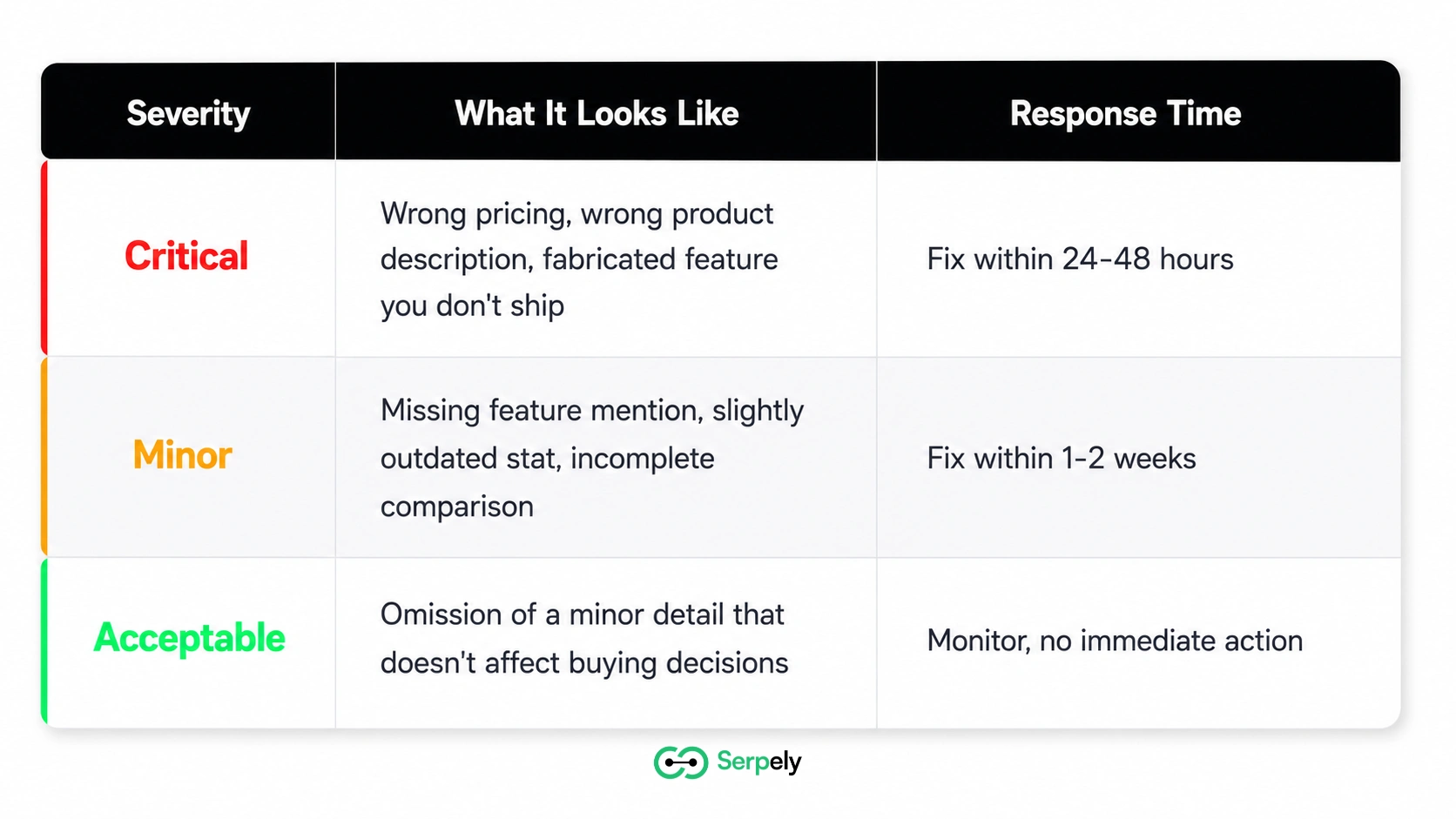
Not every hallucination deserves the same response. Sort what you find into three buckets:
Severity
What It Looks Like
Response Time
Critical
Wrong pricing, wrong product description, fabricated feature you don't ship
Fix within 24-48 hours
Minor
Missing feature mention, slightly outdated stat, incomplete comparison
Fix within 1-2 weeks
Acceptable
Omission of a minor detail that doesn't affect buying decisions
Monitor, no immediate action
Critical errors are the ones that change buying decisions. If an AI model tells a prospect you support an integration you don't ship, or quotes a price you dropped six months ago, that's not a nitpick, that's lost revenue and a confused customer on day one. Prioritize those first, always.
The Correction Playbook
Once you've triaged your findings, here's how to actually fix them.
Update your structured data first. This won't directly change what a chatbot says in a live conversation (most AI platforms read structured data as plain text rather than machine-readable schema during direct browsing), but it does feed the search indexes that power AI Overviews and Copilot, and it keeps your own site the source of truth (SearchViu).
Publish authoritative, current content. The single biggest lever you have is making sure your pricing page, your features page, and your comparison pages are current, specific, and easy for a crawler to parse. Vague marketing copy gives models room to guess. Specific numbers and feature names don't.
Submit direct feedback to the platforms. ChatGPT, Claude, and Perplexity all have some form of feedback or reporting mechanism for incorrect outputs. It's a slow lever, but a consistent one, especially for factual errors that keep recurring across sessions.
Build out your llms.txt file. This is a newer piece of the puzzle. A well-built llms.txt file, the AI-era equivalent of a sitemap, points AI systems toward your authoritative pricing, feature, and proof-point pages instead of leaving them to guess from scattered third-party mentions. Adoption is already broad among tech companies, with Anthropic, Stripe, Vercel, and Cloudflare among the brands publishing one (Limy). No major LLM provider has officially confirmed it as a ranking signal yet, but it costs little to implement and directly supports the "point AI toward the truth" strategy this whole audit is built around.
How Often Should You Run This
Monthly is the floor, not the ceiling. AI platforms push model updates every few weeks, and a hallucination that wasn't there in your last audit can appear out of nowhere after a routine update (Wellows). If you're in a competitive category where competitors are shipping new content constantly, weekly spot-checks on your highest-priority prompts are worth the extra effort.
The real value of this audit isn't the single snapshot. It's the trend line. Are errors going down over time, or creeping back in after every model refresh? That comparison is what turns a one-off checklist into an actual system.
FAQ
How often should I audit my brand's AI hallucinations?
Monthly is the recommended minimum for most brands. If you're in a fast-moving or highly competitive category, weekly checks on your top prompts are worth the extra time, since model updates can introduce new errors between cycles.
Which AI platform hallucinates the most about brands?
It varies by category and prompt type, and no platform is immune. Perplexity's inline citations tend to make its hallucinations easier to spot and trace to a source, while ChatGPT and Claude sometimes state incorrect information with no visible citation at all.
Does schema markup stop AI chatbots from hallucinating?
Not directly in live conversations, since most AI platforms currently read structured data as plain text rather than parsing it as schema during direct browsing. It still matters for search indexes that feed AI Overviews and Copilot, so it's worth keeping current regardless.
What counts as a critical hallucination versus a minor one?
Critical errors change buying decisions: wrong pricing, a fabricated feature, or an inaccurate product description. Minor errors, like an outdated stat or a missing feature mention, still need fixing but don't carry the same urgency.
Can I fix a hallucination by submitting feedback directly to ChatGPT or Claude?
Yes, most platforms have a feedback mechanism for flagging incorrect outputs. It's a slower lever than content and structured data fixes, but it's worth doing consistently for errors that keep recurring.
Is llms.txt worth implementing if no AI provider has confirmed it as a ranking factor?
Yes. Even without an official commitment from OpenAI, Anthropic, or Google to use it as a signal, it's low-cost to implement and gives AI crawlers a clear, structured path to your most accurate brand information instead of leaving them to guess.
Set Up Hallucination Alerts for Your Brand
Manual audits catch what's wrong today. Continuous monitoring catches what breaks after the next model update, before a prospect ever sees it. Try Serpely's Hallucination Alerts and put your brand's AI accuracy on autopilot.
Automating the Audit with Serpely
Running this manually every month across four platforms and a dozen prompts is doable, but it doesn't scale past a handful of brands or a lean team. This is exactly the gap Serpely's Hallucination Alerts was built to close.
Instead of manually running prompts and copying outputs into a spreadsheet, Hallucination Alerts continuously monitors what ChatGPT, Claude, Perplexity, and Gemini say about your brand and fires a severity-scored alert the moment a discrepancy shows up, whether that's a pricing error, a fabricated feature, or an outdated comparison claim. When something needs fixing, the Actions Hub turns that alert directly into a one-click content or structured data fix, so the gap between "we found an error" and "it's corrected" shrinks from weeks to hours.
For teams managing more than one or two brands, that automation is the difference between catching a critical pricing hallucination the day it appears and finding out about it from a confused prospect three weeks later.